Rembrandt's studio
First donation
“On the 23rd of the same month [March 1821] and the following days, there was an exhibition in the royal drawing school in this city of various paintings made in Paris by Mr Sinave, an artist born in Loo and educated at our drawing school. Among these paintings, which were seen by almost all the inhabitants, there was one depicting the workshop of the famous painter Rembrandt van Rhyn, who was working on the scene depicting Cleopatra and Antony, visited by his contemporaries David Teniers, Houbraken, Wouwermans Potter and others, and together they are enjoying themselves (...) playing the flute and drinking. This piece of a mediocre grotto was presented to the aforementioned drawing school by Mr Sinave, in recognition of the fact that he had received his first principles at the academy in Ypres. (…). The management of the drawing school, highly satisfied with this attentiveness on the part of Mr Sinave, honoured him on the 27th of this month with a hearty dinner at the town hall and appointed him director ordinaire."
This is how city archivist Jean-Jacques Lambin recorded in his chronicle this remarkable donation of the painting “The Studio of Rembrandt” by Jacques-Albert Senave to “his” Academy, then housed in the Ypres Cloth Hall.
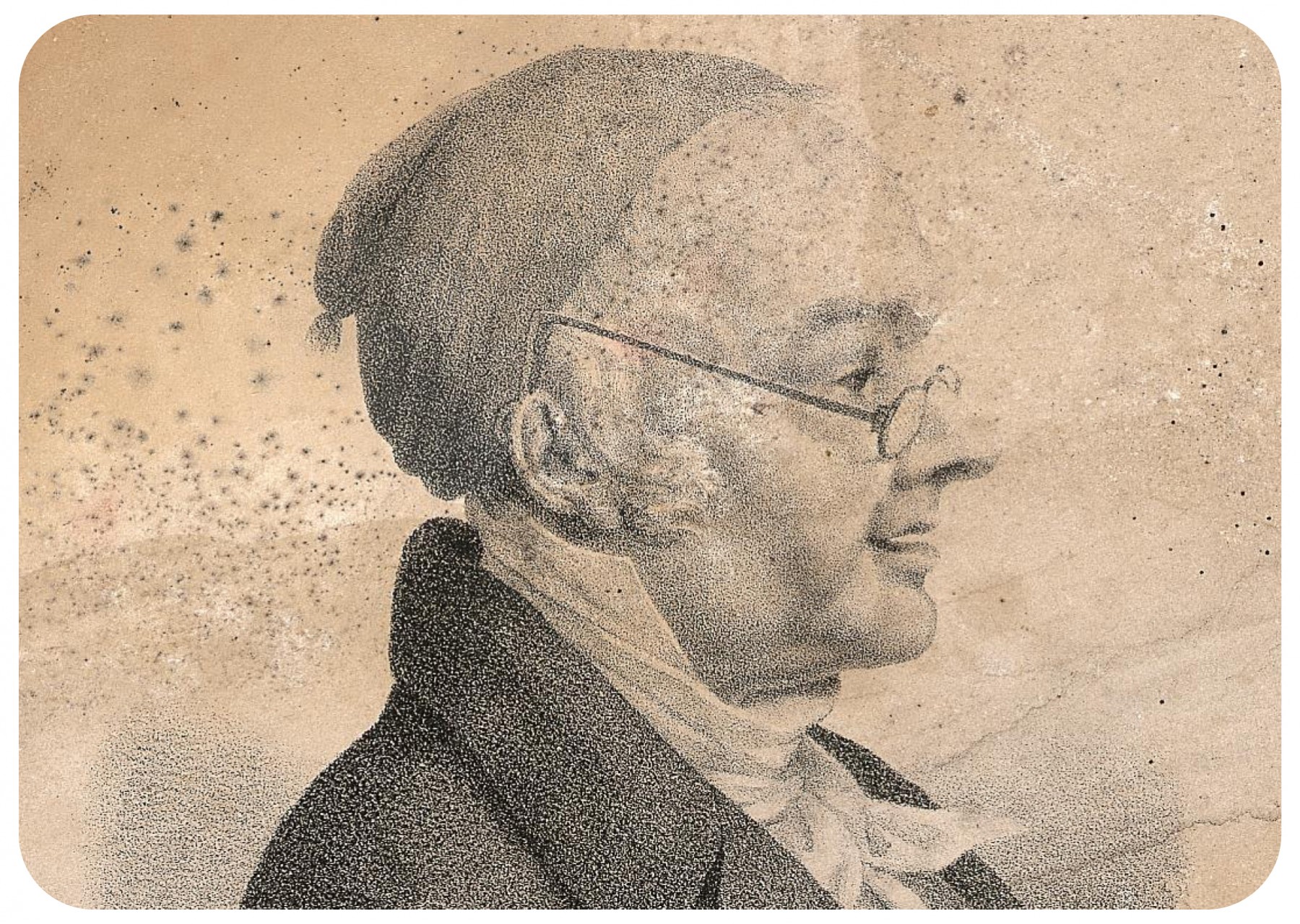
Jacques-Albert Senave
Senave had built a successful career as a painter in Paris. At the end of his life, he was honoured with a retrospective and appointed honorary director. Out of gratitude, he donated one of his paintings, “Rembrandt's Studio”, which had been an eye-catcher at the Salon of Ghent the year before.
Precursor to the Ypres Museum
This remarkable gesture by Senave inspired other artists and donations followed. The city had a small room furnished in the Cloth Hall to exhibit all these works.
In 1826, the city took the first steps towards drawing up official regulations. Charles Walwein compiled the first “catalogue” or list of “Paintings for the Museum or Study Room”. This room was the direct predecessor of the Ypres Museum!
Rembrandt's studio
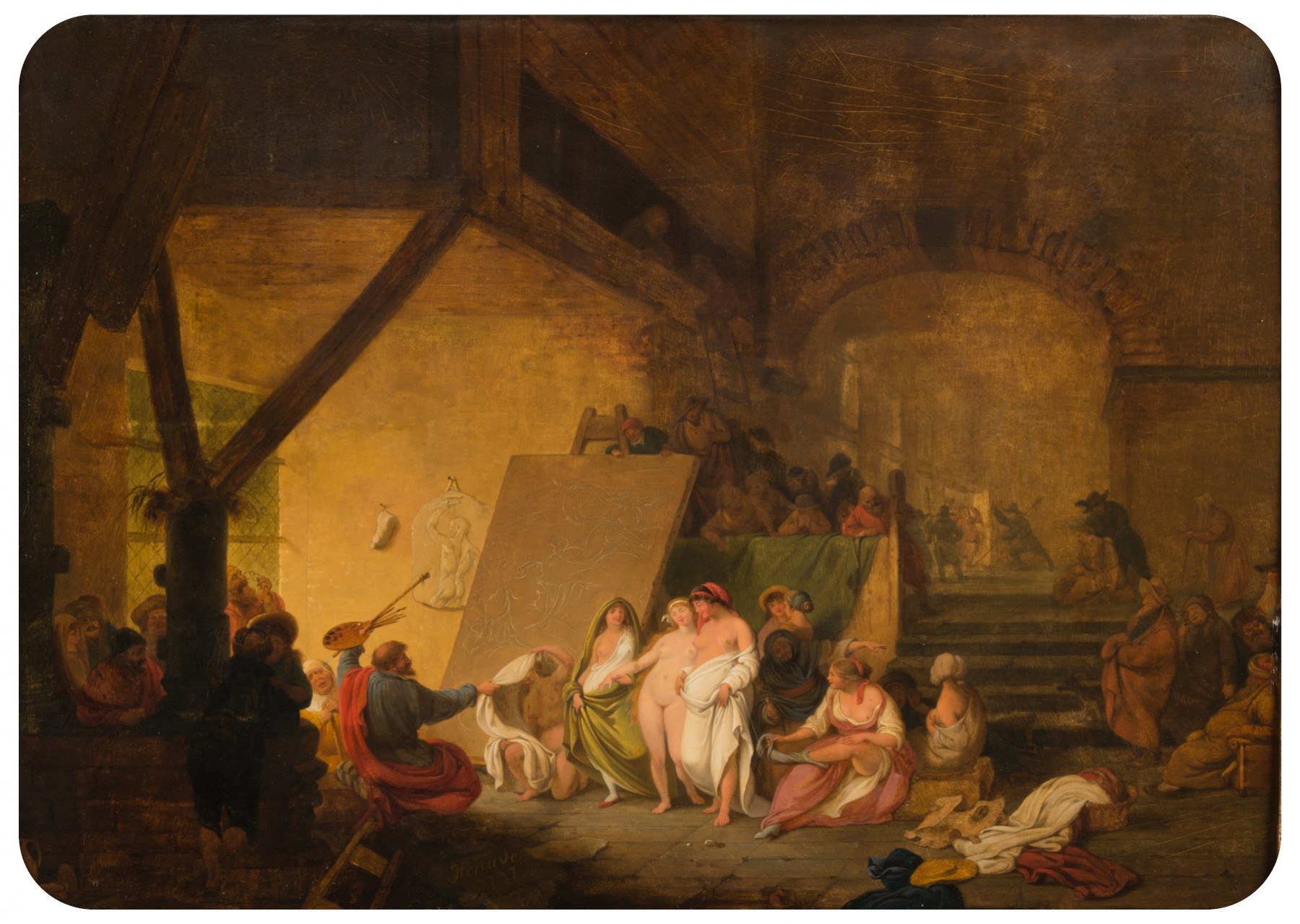
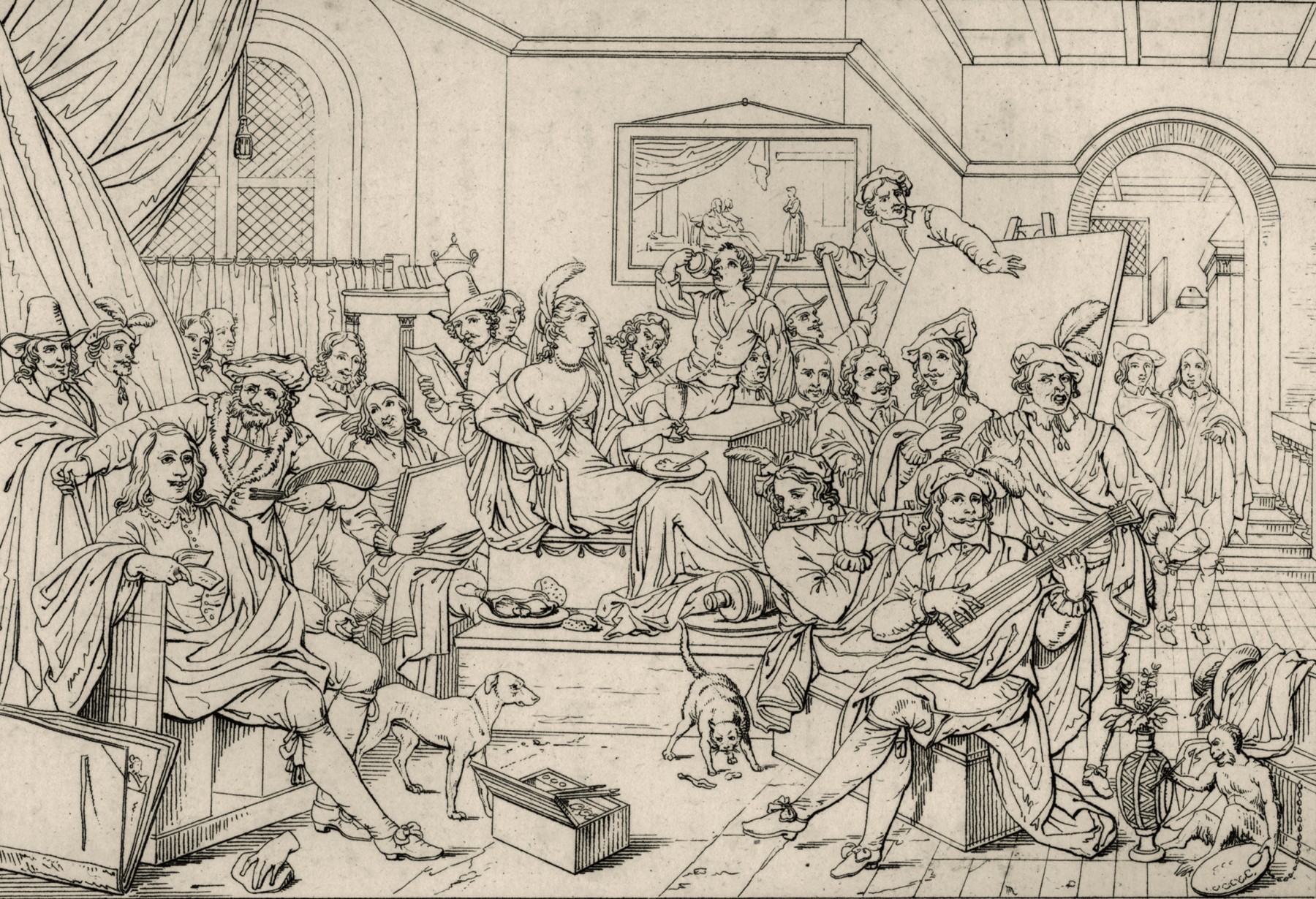
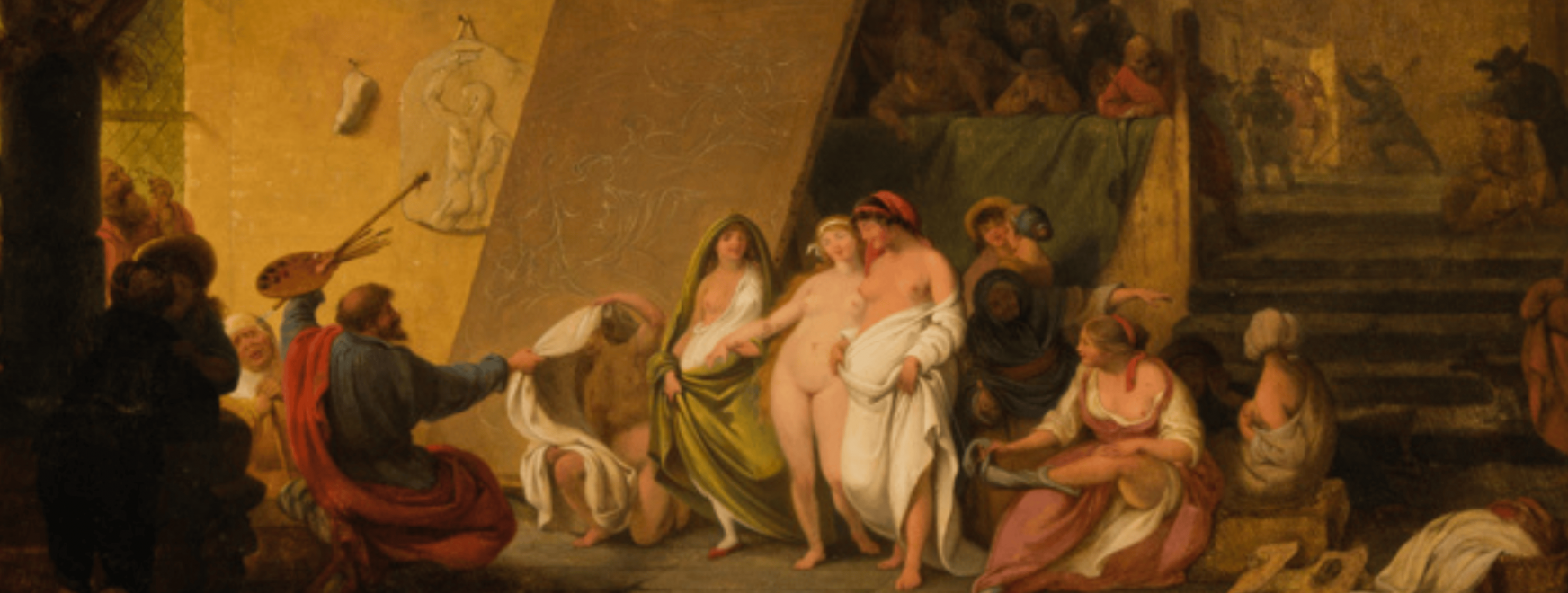
In this crowded painting, Senave depicts the studio of the Dutch painter Rembrandt van Rijn in Amsterdam. To celebrate his birthday, his pupils and fellow painters have organised a dinner at a time when the painter has invited two models. They are posing for a canvas that will depict Cleopatra and Marcus Antonius.
On the left of the painting, we see Rembrandt, with his palette and brushes at the ready, leaning towards his colleague David Teniers for consultation. On the right, the foreground is occupied by a group of singing and playing artists: Craesbeke sings, with a glass in his hand, while Jan Steen plays the flute and Adriaan Brouwer strums his guitar. Several other artists were also included: Gerard Dou, Karel Dujardin and Van Ostade.
Colourful paintings
Senave's works were once praised for their liveliness and fresh colours. The painting measured 75 by 104 cm. Today, we only know it from a black-and-white print.
In 1841, the canvas was restored for the first time by the Ypres painters Amand De Bruck and François Böhm, but in 1875, a second restoration followed, again by a Ypres painter: Théodore Ceriez. As if that were not enough, in 1914, like the rest of the museum, the canvas was completely destroyed by the ravages of war...
The Senave collection
Given his long career in Paris, Senave's work is little known and he is very sparsely represented in our public collections. Apart from the Royal Museums of Fine Arts of Belgium in Brussels, only the Ypres Museum has works by him, acquired and donated not so long ago (2003-2009): the pastel portrait of General Derutte and two interiors of artists' studios: the studio of his colleague Louis David (1800) and the imagined studio of Zeuxis (1797). The latter in particular allows us to admire the artist's fluid style, striking use of colour and imagination.